
Table of Contents
- What Is a Guitar Setup and Why It Matters
- 10 Signs Your Guitar Needs a Setup
- How Often Should You Get a Guitar Setup
- DIY Guitar Setup Tools vs. Professional Service
- Understanding Guitar Setup Cost and Value
- Visual Diagnostic Checklist for New and Used Guitars
- When to Seek Professional Help
Signs Your Guitar Needs a Setup: A Complete Guide
Last Updated: July 11, 2026
Your guitar’s playability doesn’t stay perfect forever. Environmental changes, string wear, and normal use shift the delicate balance that makes an instrument sing. Understanding the signs your guitar needs a setup can save you months of frustration and help you catch problems before they become expensive repairs. A guitar setup isn’t a luxury, it’s maintenance. Think of it like tuning your car’s engine. Without it, everything sounds off, feels wrong, and performs below its potential.
What Is a Guitar Setup and Why It Matters
A guitar setup is a series of precision adjustments that optimize your instrument’s playability, intonation, and tone. It involves tweaking the truss rod to adjust neck relief, modifying bridge and saddle height to set action, filing nut slots, and adjusting bridge saddle compensation for proper intonation across the fretboard.
A properly set up guitar responds better to your playing technique. Notes ring out clearly without buzzing. Chords ring true across all six strings. Your hand doesn’t cramp from fighting high action. Tuning stays stable through a full set. Professional setups typically address five core areas: neck relief, action height, nut slot depth and width, bridge saddle height and compensation, and electrical issues like grounding or pickup height.
10 Signs Your Guitar Needs a Setup
1. Fret Buzz and Dead Notes
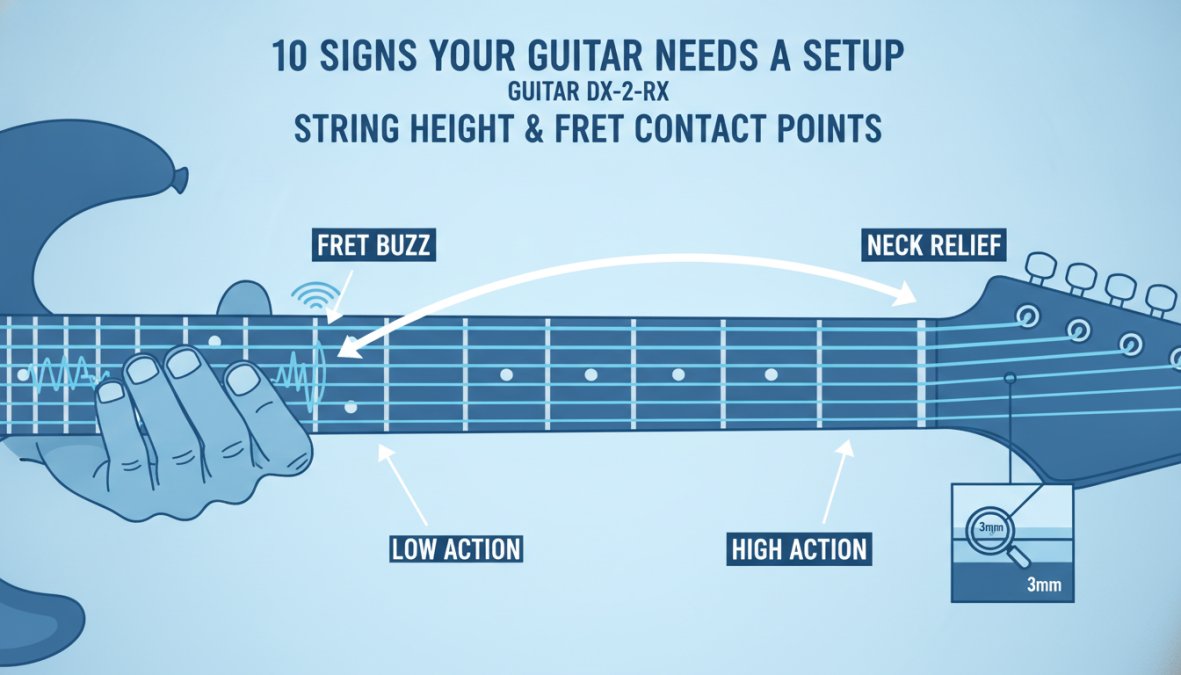
Fret buzz happens when a string vibrates against a fret it shouldn’t touch, producing a metallic rattling sound. Dead notes are specific frets where the note won’t sustain and sounds muted compared to adjacent frets.
Both problems usually stem from excessive neck relief (the neck bows forward too much), insufficient neck relief (the neck is too flat), or uneven frets. A qualified luthier can identify which by checking the neck with a straightedge. If the neck is the issue, adjusting the truss rod can fix it. If frets are worn unevenly, they’ll need crowning and leveling.
Play a note on each fret of a single string and listen carefully. If buzz appears only on one or two frets, it’s likely localized fret wear. If it appears across multiple strings in the same fret position, the neck relief is probably the culprit.
2. Action Height and Playability Problems
Action refers to the distance between the strings and the fretboard. High action makes playing physically demanding; low action that’s not set up correctly causes fret buzz. Most players find 2.0-2.4mm on the bass side and 1.8-2.0mm on the treble side (measured at the 12th fret) comfortable for electric guitars.
If your hand tires quickly during practice or you keep hitting frets unintentionally, action is likely the problem. The fix involves raising or lowering the bridge saddle, adjusting the nut slots, or both. On acoustic guitars, this typically means sanding the saddle. On electric guitars with adjustable bridges, it’s often just turning screws. A fraction of a millimeter makes a noticeable difference.
3. Intonation Issues Across the Fretboard
Intonation problems mean your guitar sounds out of tune, especially as you move up the fretboard. Open strings sound in tune, but by the 12th fret, the same string sounds sharp or flat. This is usually caused by incorrect bridge saddle compensation.
To diagnose: tune your open strings. Play the 12th fret harmonic (which should be exactly one octave above the open string). Then play the fretted note at the 12th fret. If the fretted note is noticeably sharp or flat compared to the harmonic, intonation adjustment is needed. Check this on multiple strings to confirm the pattern.
4. Tuning Stability and Neck Problems
Your guitar won’t hold tuning. You tune it, play for five minutes, and it’s sharp or flat again. Tuning instability can stem from worn tuning machines, a bowed or twisted neck, bridge saddle issues, or nut slot friction.
Check if the problem is consistent. Does the low E string always go flat? That suggests either a tuning machine issue or excessive neck relief. Does tuning drift gradually during playing? The nut slots might be too tight. A twisted neck is a serious problem requiring professional assessment. A bowed neck can often be corrected with truss rod adjustment.
5. Electrical Buzz and Grounding Issues
Electric guitars sometimes produce a hum or buzz that isn’t fret buzz, it’s an electrical issue. You might hear a 60Hz hum or buzz that changes when you touch the strings or bridge. This is a grounding problem.
The issue usually involves loose shielding inside the guitar body, a disconnected ground wire, or a bad output jack. Sometimes it’s as simple as tightening a ground wire connection. This problem won’t go away on its own and typically requires opening the guitar body to inspect the electronics.
6. Worn Frets and Diminished Sustain
After years of playing, frets wear down and flatten instead of maintaining their rounded crowns. You’ll notice that notes don’t sustain as long, and the tone becomes thin or brittle. High-wear areas (usually around the 5th-7th frets) show visible flat spots.
Fret wear requires professional restoration. A luthier levels the fretboard, then crowns each fret to restore the rounded top. This labor-intensive work can make an old guitar feel new again.
How Often Should You Get a Guitar Setup
Most musicians should have their guitar professionally set up once or twice per year. However, frequency depends on how much you play, your climate, and how aggressively you use your instrument.
If you play daily and bend strings heavily, consider a setup every 6 months. If you play casually a few times per week, once yearly is usually sufficient. The real answer is: get a setup when you notice problems. Don’t wait for a scheduled maintenance date if your guitar already sounds and feels wrong.
Setup Frequency by Climate and Environment
Environmental factors dramatically affect how often you need setups. Wood responds to humidity and temperature changes by expanding and contracting, which shifts neck relief, action height, and intonation.
In humid climates, wood absorbs moisture and swells. Necks tend to develop forward bow, action rises, and fret buzz may appear. In dry climates, wood shrinks. Necks develop back bow, action drops, and fret buzz becomes more likely.
If you live in a stable climate, you might need setups only once yearly. If you live somewhere with extreme seasonal changes, plan on setups twice yearly or whenever you notice problems.
Guitar Intonation Problems: Detection and Solutions
Intonation problems are among the most common reasons players think their guitar “just doesn’t sound good.”
To diagnose intonation precisely, use a chromatic tuner. Tune your open string. Play the 12th fret harmonic (lightly touch the string directly above the 12th fret, pluck, then release). This harmonic should show exactly one octave above the open string. Now play the fretted note at the 12th fret normally. If it’s sharp, the saddle needs to move back. If it’s flat, the saddle needs to move forward.
Check all six strings. You’ll often find the bass strings need to move in one direction while treble strings need different compensation. On acoustic guitars, a luthier will sand the saddle or remove and reposition it. On electric guitars with adjustable bridge saddles, it’s often a matter of loosening screws and moving each saddle slightly.
DIY Guitar Setup Tools vs. Professional Service
You can handle some setup tasks yourself if you have the right tools and patience. Basic tools include a straightedge, feeler gauges, a capo, and a chromatic tuner. These let you diagnose problems and make minor adjustments.
However, professional setups require specialized equipment: fret crowning files, fret leveling jigs, and nut slot files. A luthier can feel problems in the neck that a straightedge alone won’t reveal and understands how adjustments interact.
DIY setup makes sense for simple tasks: adjusting bridge saddle height on an electric guitar with individual saddle screws, filing nut slots slightly to reduce friction, or adjusting pickup height. It does NOT make sense for truss rod adjustments (which can permanently damage your guitar), fret work, or complex intonation problems. If you’re uncertain, get professional help.
Understanding Guitar Setup Cost and Value
Setup pricing depends on what needs adjustment. A basic setup addressing action, intonation, and truss rod adjustment typically costs between standard shop rates. Complex work like fret leveling or nut replacement costs significantly more.
The value is immediate and tangible. A $100-200 setup can make an unplayable guitar feel professional. I charge only $79. It can make you practice more because playing doesn’t hurt your hand. For musicians who play regularly, a setup pays for itself in improved playing experience within weeks.
Visual Diagnostic Checklist for New and Used Guitars
Use this checklist when evaluating a new or used guitar to identify setup needs before purchase:
Neck Inspection:
- Sight down the neck from the headstock toward the body for excessive bow or twists
- Check if the neck is straight or has slight forward relief (ideal)
- Look for visible cracks or separation at the headstock
Fretboard and Frets:
- Run your finger along each fret for high spots or dips
- Check for visible flat spots on frets (sign of heavy wear)
- Look for fret sprout (frets protruding beyond the fretboard edge)
Action and Bridge:
- Measure string height at the 12th fret using a ruler
- Check if the bridge is seated properly and not leaning
- Look for visible gaps between the bridge and body (on acoustic guitars)
Tuning Machines:
- Turn each tuning peg for smooth movement
- Check for loose tuning buttons or stripped posts
Electronics (Electric Guitars):
- Plug in and listen for hum or buzz with no strings played
- Test each pickup selector position
- Check volume and tone pots for crackling
Overall Condition:
- Look for cracks in the body, top, or back
- Check for loose binding or separation at seams
- Inspect for water damage, warping, or excessive wear
A guitar with minor setup needs is often a good buy if the price reflects the work required.
When to Seek Professional Help
Immediate professional attention needed:
- The neck has a visible twist or severe bow
- There are cracks in the body, top, or headstock
- Frets are severely worn with visible flat spots
- The bridge is lifting or leaning on an acoustic guitar
- Electronics produce noise that doesn’t go away
Schedule a setup soon:
- Action is noticeably high or low
- Fret buzz appears consistently across multiple strings
- Intonation is off by more than a quarter-step at the 12th fret
- Tuning won’t hold for more than a few minutes
- Nut slots are so tight they cause friction when bending strings
Can wait for next scheduled maintenance:
- Minor intonation issues
- Pickup height could be adjusted for better tone
- Tuning machines are slightly loose but functional
- Minor cosmetic issues
The difference between a minor adjustment and a major repair often comes down to timing. Catching a truss rod issue early might mean a simple adjustment. Ignoring it for months might mean permanent damage.
If your guitar feels unresponsive, sounds out of tune, or plays harder than it should, a professional setup is the answer. Guitar Dx-2-Rx provides expert guitar repair and maintenance with guaranteed 3-4 day turnaround on standard setups. Their personalized approach ensures your instrument is adjusted to match your specific sound goals and playing style, not a generic standard.
Frequently Asked Questions
How often should you get a guitar setup?
Most players benefit from a professional setup every 6–12 months, depending on climate and playing frequency. Guitars in humid environments or those experiencing temperature swings may need setup adjustments more often. New guitars should receive a professional setup before regular use. If you notice signs your guitar needs a setup—such as fret buzz, high action, or intonation drift—don't wait for a scheduled appointment. Address issues promptly to maintain playability and tone quality.
What are the main signs your guitar needs a setup?
Common signs include fret buzz when playing open strings or low frets, action that feels too high or too low, intonation that drifts sharp or flat up the neck, tuning instability, dead notes that lack sustain, and electrical buzz from grounding issues. Humidity changes can also cause neck relief problems, leading to bowed or back-bow conditions. Visual inspection of the fretboard against a straightedge and listening carefully while playing can help identify these issues early.
Can I diagnose guitar intonation problems myself?
Yes, you can perform a basic intonation check using a tuner. Tune the open string, then check the 12th fret harmonic—it should match the open string pitch. Next, fret the string at the 12th fret normally and compare. If the fretted note is sharp, the bridge saddle may need to move back; if flat, it may need to move forward. However, precise intonation adjustment requires a luthier's expertise and specialized tools. Professional setup ensures accurate bridge placement and saddle compensation across all strings.
What's the difference between DIY guitar setup tools and professional service?
Basic DIY tools like straightedges, feeler gauges, and hex wrenches can help you check neck relief, measure action, and make minor truss rod adjustments. However, professional luthiers have precision equipment, years of training, and understanding of how truss rod tension, bridge height, saddle shaping, and nut slots all interact. A professional setup addresses intonation, fret wear, electrical grounding, and playability holistically. For complex issues or if you're inexperienced, professional service delivers superior results and protects your instrument.
This article was written using GrandRanker